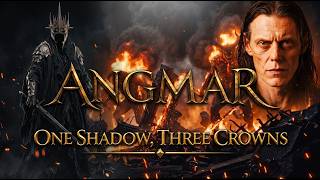
- Angmar — 1. Bölüm
In the last decades of Númenor, its dominion did not rest solely upon the island. Across the coasts of Middle-earth stood fortified havens ruled by men appointed to enforce the will of the King's Men. Among these, Umbar was the greatest—a seat of fleets and tribute, where Númenórean authority was maintained by command rather than consent. Those sent there were not envoys, but instruments of control. When the island fell, the news did not arrive as legend or uncertainty. It came as fact. The sea had swallowed Númenor. The king was gone, and no power remained to recall those who served abroad. In Umbar, confusion followed, loyalties fractured, and authority wavered. Some sought the Faithful in the north, others abandoned their posts. One commander did neither. He sealed the haven, secured the fleets, and gathered the garrisons under his rule, choosing stability over allegiance to a vanished realm. In the years that followed, Umbar endured as a remnant of Númenórean pride—hardened, resentful, and cut off from redemption. Of the man who held it, little was spoken at first. His name faded from record, but his will did not. Long before he was known in the north, before crowns were broken and kingdoms fell, the shadow had already found a servant. And only much later would Middle-earth name him the Witch-king.
Meanwhile, in the north, Arnor expanded behind shields and laws written by the victors. Forts were driven into hilllands, clans were broken, chiefs replaced, and obedience was enforced in the name of order. This was the kingdom founded by survivors who refused to be weak again—led by Elendil and upheld by his sons Isildur and Anárion. Men remembered as heroes by those they protected and tyrants by those they ruled. To Arnor, the wars in Rhudaur were necessary: borders secured, resistance crushed for the future of men. To the hillmen, they were dispossession—their sons taken for distant wars, their lands claimed by southern lords who spoke of ancient rights. And so the hillmen did not pray to Arnor's kings or wait for mercy. They turned away from the north, crossed seas and shadows, and came south to Umbar, where Azagar ruled. They did not ask him to save them. They asked him to lead.
- Angmar — 2. Bölüm
The order comes from Mordor: Umbar is to be yielded, its crown placed in the hands of a loyal nobleman. But the servant who receives it obeys only in part. Umbar is surrendered, yet its rule is given instead to Bellian, his right hand, who now sits as queen. He does not return north, nor does he remain in the city. He rides into Harad to raise its armies, for his next task is the attack on Minas Ithil, while Sauron turns his strength openly against Gondor.
In the court of Harad, the queen awaits. She is not one of men, and she demands to know what manner of creature stands before her. He answers plainly: a servant that does not age, a shape that does not stay, a hunger that learned to speak. He was promised fullness once and was betrayed by it. Now another makes promises—measured, patient, unending—and he believes him, not because he trusts, but because this time the hunger is allowed to endure. He serves until he is fed, and the Dark Lord knows better than to lie about that.
The hosts are already moving. Orcs out of Mordor, Haradrim from the south. They do not march together yet, but they will strike the same wound. Minas Ithil stands alone, too close to the shadow and too far from aid. Fear will reach its gates before the first ram does. Gondor will answer, too slowly. Osgiliath is divided. Minas Anor looks west, and Isildur commands a city that cannot be held. The orcs come through the veil, knowing the paths, the tunnels, the dark ways beneath the walls. The Haradrim come as allies—banners first, blades after. And the servant will ride with them, to command the orcs, to be fear itself. What remains when it falls? A fortress facing west. A wound that will never heal. Minas Ithil will be remade, and he will be left there—not as a conqueror who departs, but as the one who stays. Orcs will obey. Men will tremble. Gondor will learn his name without ever seeing his face. This is only the first gate he opens.
- Angmar — 3. Bölüm
In the shadowed lands of Middle-earth, a powerful ruler known as Angmar articulates a chilling philosophy: that the world's endless divisions and petty wars can only be cured by a single, unyielding will. He sees himself not as a tyrant but as a savior, bringing design to chaos, and he will stop at nothing to impose his vision of order. Meanwhile, in Gondor, the watchers perceive the stirring of a great host in the south. Riders race through desert, river, and forest to carry the warning to the kings, each bearing a fragment of the truth, until the final messenger delivers the ominous news: war has begun.
Within the royal house, brothers Anarion and Isildur confront the looming threat. They discuss the strengthening of walls and the watching of crossings, even as they plant a living tree—a symbol of hope in bitter times. Their father has been told, and the Elven kings as well, but fear must not outrun truth. Amidst these preparations, a personal tragedy unfolds: a beloved woman, Wilwarin, lies dying of fever. A captain's plea reveals a harrowing truth—she was made to wait while those of higher station received care. The captain's grief-stricken accusation lays bare the cruel inequalities even in times of crisis.
As the shadow gathers openly, the house of Gondor must balance the sword and the seed, praying that one outlives the other. The film weaves a rich tapestry of political tension, familial love, and the heavy burden of leadership, all set against the backdrop of an encroaching darkness that threatens to consume everything.
- Angmar — 4. Bölüm
In the harsh lands of Rhûn, a boy named Khamûl endures the mockery of his peers, who call him 'orc skin' and shun him for his strange blood. His grandmother consoles him with tales of Asgard, a once-fair kingdom beyond the eastern sea, destroyed by pride and war. She tells him their people are not cursed but survivors of a fallen realm, and that he carries the blood of kings. Inspired, Khamûl vows to become a general and reclaim their lost homeland. Meanwhile, a king named Valakhân rises in Rhûn, beloved by his people, and dreams of strength and honor, turning his gaze toward the Iron Hills and war against the dwarves. But his design is shattered by ruin, and Rhûn falls back into grief and division. Yet the dream lingers in some hearts. Years later, Khamûl encounters the ancient spider Ungoliant, who warns of betrayal by Azaroth and Meron, claiming all will betray him. She speaks of a dark blade that will strike from the hands of one he trusts. Khamûl, now a man, refuses to believe her, but her words echo the fragility of loyalty and the hunger for power that corrupts all. As old sorrows and new ambitions collide, Khamûl must navigate a world where trust is fleeting and the past never truly dies.
- Angmar — 5. Bölüm
The kingdom stands on the edge of ruin. A queen is dead, her murder unclaimed but not forgotten, and the king's court is rife with suspicion. From the south, a fleet of five hundred ships has struck without warning, reducing a city to ash in a single day. The attackers are no common foe: their fire is the work of Umbar, a craft guarded and given only to those who understand its danger. At the center of this storm is Azeroth, a name the old kings knew in their youth, and Belian, a fierce warrior set as queen by his side—a woman who is no woman at all, but something forged in the same dark furnaces.
Meanwhile, far from the councils of power, a lone ship has already sailed into the uttermost west. Amandil, Lord of Andunia, last among the faithful of Númenor, saw the ruin drawing near and chose a path long forbidden: to seek a mercy not granted to men since the elder days. No sail returned. No word was ever heard again. Whether he reached his aim or was claimed by the deep remains a mystery even to the wise.
Now the king must walk into a trap he cannot turn aside from, his eyes were turned eastward while the south went blind. Spies have vanished into Umbar, and a traitor may sit among his own captains. As orcs stir in the wake of the assault and the Black Númenóreans' hatred of Gondor burns anew, the faithful are left to wonder: what hope remains when the sea itself swallows the brave, and the fire that comes is not of any simple smith?
- Angmar — 6. Bölüm
In a realm where old alliances fray and ancient powers stir, a king named Herammore is confronted by a mysterious stranger, Anitar, who reveals a devastating truth: his son was not lost to fate but murdered by a Gondorian spy. As the southern host marches and the capital braces for siege, Herammore is torn between raising armies for a war he never wanted and the crushing weight of a father's grief. Anitar offers him a ring forged in fires older than men—a ring that promises dominion over flesh, fear, and time itself, and whispers of paths beyond death that mortal hands were never meant to touch.
Meanwhile, a dragon rider arrives seeking shelter from the rain, and a ship's captain is drawn into a web of riddles and old loyalties. The elves of Heland close their eyes to Gondor's steel, and the south awakens beneath strong rulers. As the enemy gathers at the gates, Herammore must rally every man, woman, and child to defend their home—but the true battle lies within, where the ring's promise of defying death may cost him everything he seeks to protect. The film weaves a tapestry of loss, power, and the terrible choices that shape futures, where children become futures and kings fear them more than warriors.
- Angmar — 7. Bölüm
The land of Angmar is steeped in blood and bitter memory. Dark tidings arrive: orcs have ambushed an Arryn's lady, leaving her body hanging from a tree—a cruelty that ignites fear in the city and fuels a war without end. Amid this chaos, Muriel confronts the grandmother who abandoned her, a spirit of nature who admits to stealing her from her mother's arms and leaving her to rot in the desert. Their reunion is a storm of accusation and hate, ending with a curse: Muriel's bones will rest beneath the dwarf mountain. Cast adrift in a wasteland of shifting loyalties, Muriel crosses paths with a dwarf patrol and a desperate creature who claims not to be an orc but a father watching over a daughter who fights for the Easterlings. Mercy is demanded, but the dwarf has no child and no pity—only a blade. As the war grinds on, whispers of Elrond's blade and broken black ships at Umbar echo through the smoke, while a mysterious woman named Balian, daughter of nobody, is drawn into a family reunion she never sought. Galadriel herself steps from the shadows, and an old friend of the elves seeks to finish what was begun. In this world of curses and shattered dreams, every soul is bound to a fate darker than war.
- Angmar — 8. Bölüm
In the vast, shadowed lands of Middle-earth, the threat of Mordor looms larger than ever. Sauron, the Dark Lord, has returned to power, and his influence spreads like a creeping fog, turning once-distant fears into an imminent war. As the free peoples of Middle-earth grapple with the growing darkness, an ancient amulet is given to Arwen, a young elf of Rivendell, with the promise that it will bring luck to her and those around her. But luck is a fragile thing, and the amulet's true origins remain a mystery, even to those who gift it.
Meanwhile, in the court of the Woodland Realm, King Oropher and his son Prince Thranduil receive a desperate envoy bearing dark tidings: Sauron's strength is gathering, and Mordor is becoming a kingdom of war. The envoy pleads for unity, urging the elves to stand with Gondor and the other realms before it is too late. But old resentments run deep. Oropher remembers the arrogance of men, their stone cities and drawn borders, and he refuses to kneel to Gondor's kings. His pride, and the pride of his realm, threatens to isolate the Woodland Realm from the alliance that might be their only hope.
As tensions rise and loyalties are tested, the film weaves a tapestry of grief, ambition, and the seductive pull of power. From the dying cries of a mysterious queen to the whispered promises of a dark master, every choice carries the weight of survival. In a world where trust is scarce and ancient grudges linger, even the bravest must confront the cost of standing alone.
- Angmar — 9. Bölüm
In the scorched lands beyond Mordor, Queen Muriel the Red rules Rhûn under the watchful eye of Kamul, who commands her to join his war against Gondor. Unwilling to march alone into darkness, she travels to a remote desert outpost to recruit her oldest allies: Belian, a dragon rider cursed since childhood, and the warrior Urzul, who now tends sheep with little success. Belian and Azaroth, her dragon, have found a fragile peace in the sand and sun, far from the battlefields that once defined them. Yet Muriel's arrival stirs old bonds and older wounds. She speaks of friendship and trust, but Belian sees the truth—Muriel seeks a title, not a cause. As the two women trade memories of loss and survival, the conversation turns to the half-million warriors who fell in a single day, and to the dark being who vanished into the south, leaving only rumors of bad deeds. Urzul greets Muriel with wary respect, his eyes reading the war written on her face. Azaroth, ever watchful, warns that war belongs where it is, not here among the dunes. But Muriel's plea is not easily dismissed: Kamul has promised her a miracle, and she clings to it. In the quiet heat of the desert, old loyalties are tested, and the question of what any of them truly wants—peace, revenge, or something long buried—hangs heavy in the air.
- Angmar — 10. Bölüm
The final battle has begun upon the black and ashen plain of Dagolad, where the armies of the West—Elves, Men, and their allies—stand united against the dark hosts of Sauron. Beneath a darkened sky, High King Gil-galad leads the Elven forces, flanked by Elrond and the warriors of the golden woods. With them stands Elendil, High King of the Dúnedain, and his sons, heirs to the blood of Númenor. Before them stretch legions of orcs, trolls, and Easterlings, a tide of shadow ready to consume all that is free.
As the battle rages, a young warrior named Azeroth finds himself torn between the call of blood and the weight of conscience. He encounters a mysterious figure, Özil, who speaks of loss and the fear of dying alone, and a woman named Mielle who dreams of reuniting with her mother beyond death. These fleeting moments of humanity pierce the carnage, revealing the personal stakes beneath the epic conflict. Yet the shadow does not relent, and whispers of Sauron's true nature—a fallen spirit of great power who hides his darkness behind fair words—echo through the ranks.
With the pit fires burning and the enemy pressing ever closer, the leaders of the West must hold the line. Azeroth is confronted by a wraith who claims to be his father, a chilling reminder that the enemy can corrupt even the closest bonds. As the forces of Mordor surge forward, the defenders face a simple, terrible truth: if Sauron is not broken now, no forest, no home, no child will remain untouched. The battle for Middle-earth demands everything—and the cost of failure is absolute.
- Angmar — 11. Bölüm
The world of Angmar is one of fractured alliances and lingering wounds. King Thanduel of the elves remembers the day a sea-soaked stranger arrived on his shores with scarcely a kingdom left to his name—and welcomed him as an equal. Now that stranger, King Elen, must forge a coalition with those who distrust men, for the enemy's shadow stretches across the land. As warriors gather and old grievances surface, the leaders debate strategy: strike at the black gate while the enemy is weakened, or bind the darkness with a long and bitter siege. Meanwhile, a wraith's words echo through the ranks, and the city of Osgiliath becomes a prize neither side can afford to lose.
In the midst of this gathering storm, personal tragedies unfold. A lord named Azeroth searches desperately for Bellian, a woman he fears is lost, while others speak of children waiting at home and meals left uncooked. The dialogue reveals a world where every decision carries the weight of families torn apart and futures uncertain. As the alliance marches toward the black gate at first light, the question remains: can unity hold when the shadow is patient and the cost of victory may be everything they have left? The film captures the tension between hope and despair, the clash of swords and wills, and the quiet moments of longing that make the epic personal.
- Angmar — 12. Bölüm
In the year 539 of the Third Age, Osgiliath stands in all its splendor, its white towers and magnificent bridges rising above the Anduin. Centuries after the War of the Last Alliance, Gondor has grown powerful once more under King Romendacil I. Into this glittering capital come travelers in filthy cloaks, among them Azog and the woman in shadow, who marvel at crowded markets and towering palaces. But admiration curdles into bitterness when Azog beholds the great statues honoring Isildur and Anarion and the heroes who defeated Sauron—monuments to the destruction of everything he once fought for.
Forced to move unnoticed, the travelers must first obtain new garments, for in their current rags they look like priests of darkness. To do so, they must wield the most evil thing ever forged—a coin—an object of such power that all, rich or poor, elf or man, would kill to possess it. As they navigate the city's alliances and rivalries, old dreams surface: a child's wish to dwell in Osgiliath, an empire to be called Iron. In Sindarin, iron is Ang, and home is Mar—Angmar, the Iron Home, or the Home of Iron, depending on the anger of the moment. But the name stirs memories of Morgoth's realm, and the shadow of a master not easily escaped.
Against the grandeur of Gondor, a bargain is struck and broken, and a new power begins to take shape—one that will test loyalties, demand sacrifice, and forge a destiny from the ashes of old wars.